The automotive sector operates on precision, speed, and reliability. When a critical component fails, whether…
December 10, 2025
Urgent Deliveries to Remote Forestry Sites: What to Consider
The forestry sector is a cornerstone of the Nordic, Baltic, and Polish economies, supplying wood and timber products across Europe. Forestry operations are unique: they take place in remote, rural locations and demand the deployment of highly specialised vehicles and heavy equipment. Some forestry operations calculate that every minute of downtime costs roughly €20. Downtime, then, has the potential to cost thousands a day.
Unlike factory equipment, when a harvester breaks down in the forest, you can’t just send an employee down the road for replacement parts. The complexity of getting urgent deliveries to remote sites requires a specialised forestry logistics network that understands the sector’s distinct challenges.

The challenges facing forestry sites when machines break down
Limited access to spare parts and tools
Problem: Remote sites are often hundreds of kilometres from suppliers or service centres, and operations must travel light, meaning bulky spare parts and tools are often not on site.
Impact: Even small breakdowns can lead to long periods of downtime if the right parts aren’t on hand.
Example: A damaged hydraulic hose might take days to replace if it must be shipped in from a regional depot.
Transport and accessibility issues
Problem: Poor road access, rugged terrain, and seasonal weather (e.g., mud, snow, or flooding) can delay both personnel and parts deliveries.
Impact: Even if repairs are planned quickly, simply reaching the site can be a major obstacle.
Harsh environmental conditions
Problem: Equipment in forestry environments faces exposure to mud, debris, moisture, and fluctuating temperatures.
Impact: These conditions not only increase wear and tear but also make field repairs physically difficult and sometimes unsafe.
Safety risks
Problem: Urgent repairs may need to be done under pressure and in less-than-ideal conditions.
Impact: Improvised fixes, lack of lifting equipment, or fatigue can lead to accidents or further damage.
Supply chain delays
Problem: Global supply chain pressures (especially for specialised forestry equipment) can mean long lead times for parts.
Impact: Operators may resort to temporary fixes that reduce efficiency or increase long-term maintenance needs.
Weather-dependent scheduling
Problem: Heavy rainfall, snow, or extreme cold can restrict both repair work and transport to the site.
Impact: Repairs may be delayed or abandoned until conditions improve.
Navigating the challenges of delivering to forestry sites
Access to remote locations
The primary challenge in forestry is access. Remote sites are often kilometres away from main roads, and the conditions of the land are constantly changing based on weather and season. Simply put, standard delivery vans may not operate effectively in rural environments.
We handle deliveries to remote locations in a few ways. Firstly, we can use our PUDO points. These are secure locations where engineers can collect spare parts on their way to the site. We can also deliver directly to an engineer’s van or car. So, in the morning, they can head straight to site. And whenever it’s practical and safe to do so, we can deliver directly to the site as well.
Guaranteeing delivery
In forestry operations, every minute of downtime costs forest owners and contractors money. The huge demand for wood means equipment must operate reliably all year round, felling and loading trees onto trailers no matter the weather. When an event requiring a replacement part occurs, the clock is ticking.
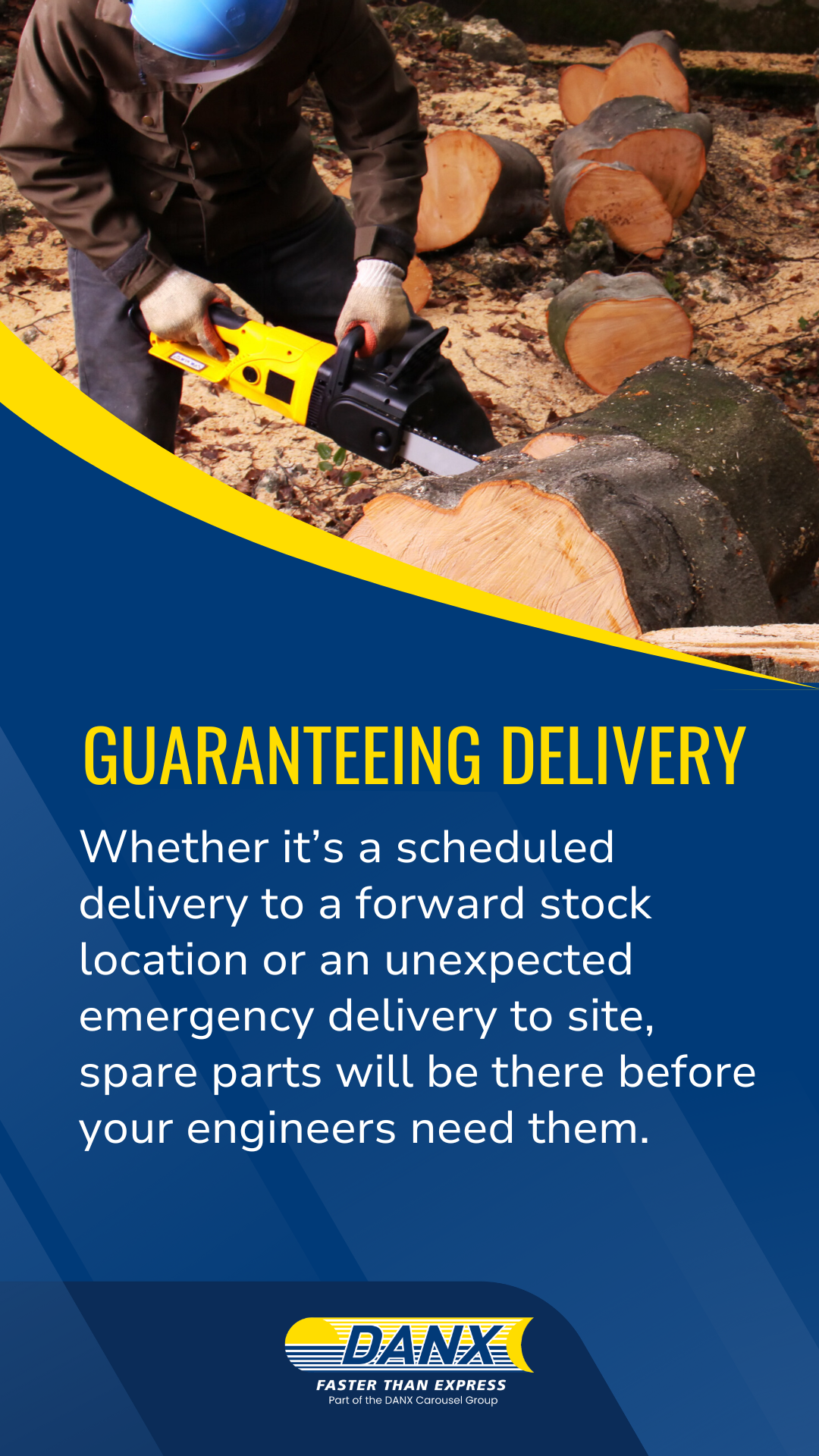
We deliver urgently needed parts night or day, ensuring that working operations on the sites can resume with minimal delay. Whether it’s a scheduled delivery to a forward stock location or an unexpected emergency delivery to site, spare parts will be there before your engineers need them. Our final mile service gives us the ability to deliver before business hours. This means that contractors and working teams can start their day with the parts in hand, ready to start repairs immediately.
Compliance and responsibility in the forest
Forestry is a highly regulated business, particularly in the Nordics. Compliance with environmental regulations, working land laws, and transportation standards is non-negotiable.
Forest management teams and forest owners require logistics partners who demonstrate a shared value and commitment to reducing their impact on the environment. We aim to reduce our carbon impact wherever possible. Our sustainable logistics services focus on optimised network routing to minimise mileage and fuel consumption, which helps customers meet their own environmental compliance targets.
Choose the right partner for your logistics needs
By selecting a partner with the specialised network, technology, and understanding needed to manage deliveries to remote forestry sites, companies can ensure the smooth transportation of spare parts and reduce the potential impact of breakdowns.
Get in touch with our team for a tailored approach to your logistical issues and see how DANX can keep your operations running smoothly with on-time deliveries that keep your engineers on the tools and your machinery up and running.
Related Posts